Signature shop windows on a small budget: what big brands do and how to do it in your shop
Big brands spend on one window what a neighbourhood shop takes in over months. And yet what makes someone stop isn't money. I'll show you what they pay for and how to get the same with little.
Lots of people with small shops write to me after seeing the windows of Galeries Lafayette, Harvey Nichols or Loewe on Instagram. Always with the same line: "Juan Carlos, I can't afford that". And it's true, you can't. But let me tell you a secret from 28 years of dressing windows, from Zara to Chanel: what makes a person stop in front of a pane of glass isn't money. It's the idea. Money only decides the scale you tell it at.
In short: a signature window on a small budget uses the same principles as a big brand's: one single idea, a lead colour, repetition, light and the product up front. What changes is the scale and the materials, not the judgement.
What big brands pay for when they pay a lot
Look at these three. Galeries Lafayette did it all in white, with paper trees and staircases. Harvey Nichols in London built a frozen forest with mannequins that seem to step out of a dream. And this 2021 window is a snowy landscape in miniature with its own illuminated sign.
Galeries Lafayette, Paris, 2016.
Harvey Nichols, London.
Window from November 2021 (press photo).
Behind each one there are months of work, a team of designers and installers, pieces made to measure that only serve that window, theatre lighting and sometimes mechanisms that move the figures. That's what the money buys. And that's the only thing you won't be able to copy.
Everything else, you can. Because if you take the money away from these windows, underneath there are five decisions that cost nothing: an idea, a colour, a rhythm, a light and a product that leads. Let's go one by one, seeing how they do it and how you do it.
1. One single idea
How the big ones do it: Moschino in London solved it with humour. Giant light-bulb letters, a green tree and, sitting on top of the X, the customer dressed in what they want to sell you. An idea you understand in one second from across the street.
Moschino, London.
How you do it: look for an idea that fits in one sentence. "A tree made only of silver baubles" is an idea. "A bit of everything so it looks nice" isn't. If you can't tell it in one sentence, you don't have it yet.
2. One colour, and be radical
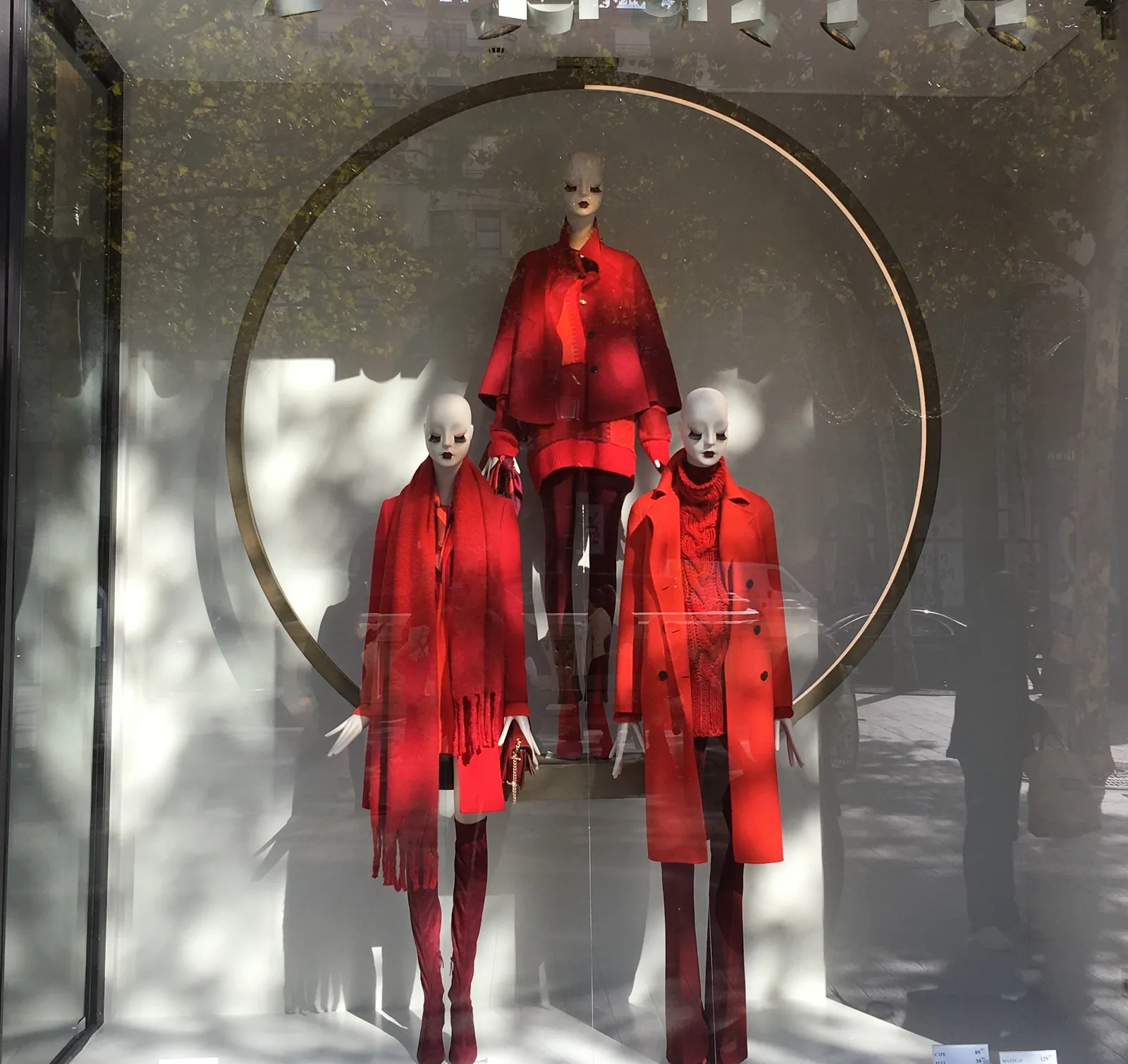
How the big ones do it: I put this window together at Zara in Paris. Three mannequins dressed in red from head to toe, in front of a hoop. Nothing else. Loewe did the same in white: white branches, a white floor and the clothes speaking for themselves.
Zara, Paris. Photo: Juan Carlos Barrón.
How you do it: colour is the cheapest thing there is. Choose one and make everything in the window respect it: product, background, paper, ribbons. One colour carried well looks expensive. Five mixed colours look like a bazaar, however much you've spent. When you're torn between adding and removing, remove.
3. Repeat to create rhythm
How the big ones do it: twelve identical penguins on ice pedestals. Silver animals repeated on a blue background. Repetition catches the eye because the eye looks for the pattern.
Rhythm decorates too.
Silver on blue (via The Impression).
Loewe.
How you do it: repeat a cheap object many times. Silver baubles of different sizes stacked into a tree. A whole floor of metallic balloons. Fifty identical boxes wrapped in the same paper. A humble object, repeated with intent, becomes an installation.
A tree made only of silver baubles.
Paris. Photo: Juan Carlos Barrón.
4. Light, which is half the scene
How the big ones do it: theatre lighting, custom-made illuminated signs, dressing-room frames of light bulbs that turn the entrance into a stage where people want to take a photo.
With Agent Provocateur, rue Cambon, Paris.
How you do it: a curtain of warm lights and a simple neon. I put this one together at Teresa in Madrid: pink background, falling lights, a mannequin and a word in neon. When it gets dark, it changes the whole street. And notice this: your window works above all when the shop is closed and people are out walking. Without light, it doesn't exist.
Teresa, Madrid. Photo: Juan Carlos Barrón.
5. The product leads
This is the most expensive mistake I see, and small and big shops both make it: the decoration eats the product. The window looks beautiful, people take photos and nobody knows what you sell. Big brands are clear about it: the set is the stage, the star is the clothing. In a small shop this matters even more, because you have fewer metres of glass. Put the three or four pieces you want to sell up front, at eye level. With a clear price.
6. Write on the glass
Big brands rarely use this, and for you it's almost free. A vinyl "Happy Holidays", a "Wishing you happy holidays", a well-designed sale sign. Look at this Roberto Verino window in Ourense: black and white, white dots acting as snow and the mid-season message. Change the text and the product, and the same window sells something else. You reuse the work and save money.
Roberto Verino, Ourense. Photo: Juan Carlos Barrón.
Where to spend and where not to
+Spend on warm light that works at night. It's what shows most from the street.
+Spend on one lead element, just one, that is the idea.
+Don't spend on lots of different decorations: repeat a cheap one.
+Don't spend on changing the whole window every season: transform it with colour, text and product.
+Keep and reuse. Good materials come out again next year with another idea.
And when Christmas comes
It's the big date of the year for any window, large or small. Decide the idea in mid-October and install in the first half of November, so that Black Friday, at the end of the month, finds you with everything up. Check the lights and the gaps left by sold pieces every week. And after Twelfth Night, don't take it all down at once: transform it.
Your checklist before installing
+One sentence that sums up the idea.
+One lead colour and, at most, one supporting colour.
+One repeated object that creates rhythm.
+Warm light that works at night.
+The product up front, at eye level and with a price.
+Something written on the glass.
And if you're in Zamora, drop by Balborraz 14 when we open: you'll see everything I've told you here, live.
Frequently asked questions
Can you make a good shop window on a small budget?+
Yes. Big brands' windows work thanks to five decisions that cost no money: an idea, a colour, repetition, light and the product up front. The budget only changes the scale and the materials.
What should a small window budget be spent on?+
On warm light that works at night and on a single lead element. Better to repeat a cheap object than buy lots of different decorations.
When should a Christmas window go up?+
In the first half of November, so it's in place before Black Friday at the end of the month.
Who's writing
Juan Carlos Barrón
Web designer, event organiser, visual merchandiser, window dresser and retail consultant with 28 years in stores such as Zara, Chanel, Lladró and Galeries Lafayette. Now, from the beautiful Calle Balborraz, at number 14, in Zamora, to the world: in Spanish, English and French.