What to see in Zamora in one day: from the Plaza Mayor to the Duero, step by step
Zamora can be walked in a day, and every step holds Romanesque stone, river and a story worth telling. Here's the route I'd take with just a few hours: from the Plaza Mayor to the Duero, without hurry.
Zamora is a city best told on foot. It has twenty-four Romanesque churches packed into little more than a square kilometre, a cathedral with a dome that looks as if it were brought from Byzantium, a river that wraps around it from the south, and streets that, if you pay attention, still smell of workshop. You don't need a week or a car: you need good legs, a day with light and the will to look up.
This is the route I'd take with only a few hours. It's not an official guide and doesn't pretend to be: it's the walk of someone who lives here, who has his workshop on Calle Balborraz and has been crossing these stones for years. It runs from the Plaza Mayor to the Duero, downhill — always easier.
Plaza Mayor: the starting point
Everything begins here. Zamora's Plaza Mayor isn't the largest in Spain, but it has everything you need: the 15th-century Old Town Hall with its archway, the church of San Juan de Puerta Nueva — 12th-century Romanesque — and a Wednesday and Saturday morning market that still smells of produce from the fields. It's the best place for a coffee before you set off.
San Juan de Puerta Nueva is the first Romanesque church of the day, and it won't be the last. Look at the rose window on the south façade and the western doorway: it's a good way to calibrate your eye for everything that follows.
The cathedral: a dome you don't expect
From the Plaza Mayor, walk west along the Rúa de los Francos. In five minutes you reach Zamora Cathedral, consecrated in 1174. From outside it doesn't impress as much as other Castilian cathedrals: it's lower, more discreet. But when you step inside and look up, the ribbed dome stops you dead. It's a Byzantine-influenced dome covered in stone scales, unlike anything you'll have seen in Castile. Art historians compare it with the domes of Poitiers, Cahors and Périgueux in France, and with Hagia Sophia in Constantinople. It's no exaggeration: the scales and the geometry are right there.
Zamora's Holy Week, declared of International Tourist Interest.
Entry to the cathedral museum costs 6 euros and includes the hall of 15th-century Flemish tapestries, which is worth the price on its own. Usual hours: 10 am to 2 pm and 5 pm to 8 pm (closed Mondays in winter). Check hours on the diocese website before you go, as they change with the season.
The castle and the views
Right beside the cathedral, to the west, stands Zamora's castle. It dates from the 11th century, was rebuilt several times and today hosts temporary exhibitions. Entry is free. But the best thing about the castle is the view from the park around it: the Duero below, the fields on the far bank and, in winter, a golden light that turns everything into a photograph.
What to see in Zamora if you love Romanesque architecture
Zamora has more Romanesque churches per square metre than almost any city in Europe. Twenty-four documented churches in an old town you can cross on foot in twenty minutes. You won't see them all in a day, so here are the ones I wouldn't skip.
+Santa María Magdalena (12th century): the finest Romanesque doorway in the city, with archivolts that deserve ten minutes of your time.
+Santiago del Burgo (12th century): three naves, three apses, textbook Romanesque. Right in the centre.
+San Cipriano (11th century): one of the oldest, with a collection of historiated capitals.
+Santo Tomé (12th century): doorway with archivolts and carved corbels. Easy to walk past if you're not looking.
+San Juan de Puerta Nueva (12th century): the one at the Plaza Mayor, you've already seen it.
If Romanesque architecture truly interests you, Terranostrum documents a route of sixteen visitable churches within the old town. You can devote a whole morning to them or fit them in between the stops on this route.
Calle Balborraz: from the centre to the river
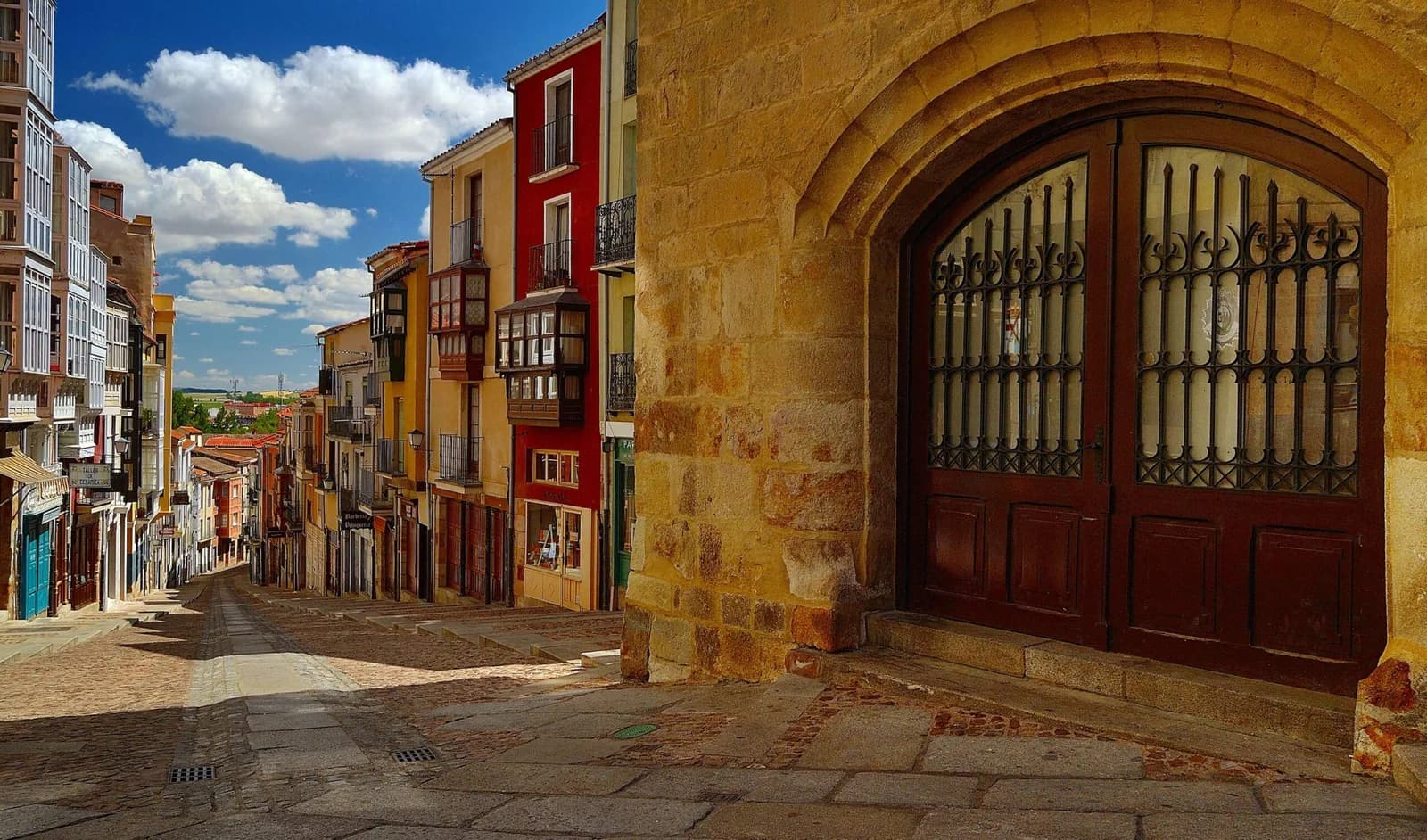
From the Plaza Mayor, Calle Balborraz runs downhill — a cobbled slope with colourful houses, wooden galleries and modernist buildings such as the Casa de Faustina Leirado (Francesc Ferriol, 1910). This street has been Zamora's artisans' street for a thousand years: coppersmiths, wool merchants, blacksmiths. And now, at number 14, Barronico.
The Balborraz slope, on the way down to the Duero.
I wrote a whole post about Balborraz, its Arabic name and its history of crafts. If you want the long version, here it is: <a href="/en/blog/calle-balborraz-zamora-historia">Calle Balborraz in Zamora: a thousand years of artisans, and now Barronico</a>.
The Duero: bridge, watermills and riverbank
At the bottom of Balborraz you reach the river. The Duero in Zamora isn't a backdrop: it's the backbone of the city. There are three things you can't miss here.
The Stone Bridge
The Puente de Piedra dates from the 13th century, is about 280 metres long and has fifteen arches. Today it's pedestrian, and crossing it at sunset with the cathedral and city walls silhouetted against the sky is the best ending to this route I can think of. Wear comfortable shoes: the cobbles are uneven.
The Aceñas de Olivares
Downstream of the bridge stand the Aceñas de Olivares, medieval flour mills built over the river. The first documentary record dates to 986. Today they serve as an interpretation centre and can be visited (free entry when there's an exhibition). The image of the mills with water flowing through the arches is one of the most recognisable sights of the city.
The old town descends towards the Duero.
The riverbank
If your legs still have something left, the riverside walk along the right bank of the Duero is the perfect rest after so much stone. Plane trees, benches and, if you come in spring, storks on every bell tower you can see from below.
Two museums worth visiting
Zamora has several museums, but if you can only choose two, these are the ones I'd recommend.
Ethnographic Museum of Castilla y León
More than 10,000 pieces on rural life, trades and traditions of Castilla y León. This isn't a dusty museum of glass cases: the display is modern and well thought out. Entry: 3 euros. Tuesday to Saturday 10 am to 2 pm and 5 pm to 8 pm; Sundays and holidays 10 am to 2 pm. Closed Mondays.
Holy Week Museum
Zamora's Holy Week is declared of International Tourist Interest. This museum gathers the processional floats, robes and history of the brotherhoods. You don't need to be devout to appreciate the carving of the figures and the weight of the tradition. Entry: 4 euros.
Eating in Zamora: the practical side
I'm not going to give you a restaurant list because they change and everyone has their own budget. What I will say is: find somewhere around the Plaza Mayor or San Juan to eat between the morning and afternoon visits, and order whatever is in season. In autumn, mushrooms. In winter, local meat. Zamora is a city where you eat well without paying capital prices.
+Meal times are still Castilian: 2 pm to 3:30 pm for lunch, 9 pm to 10:30 pm for dinner. Many places close on Sunday evenings.
+The wines of Toro are fifteen minutes away by car. Ask for a young Toro red: it's the local wine and worth trying.
+If you're in a hurry, the tapas bars on Calle Herreros and around solve a quick lunch.
Mental map of the route
You don't need Google Maps for this route: everything is on foot and intuitive. But to make it clear, here's the order.
+Plaza Mayor → San Juan de Puerta Nueva (you're already there).
+Rúa de los Francos → Cathedral and Cathedral Museum.
+Castle and castle park (views).
+Back to the centre: Romanesque churches (Santa María Magdalena, Santiago del Burgo, San Cipriano).
+Calle Balborraz → down to the Duero.
+Stone Bridge → Aceñas de Olivares → riverbank.
+Ethnographic Museum and/or Holy Week Museum (depending on time and energy).
If you start at 10 am and stop for lunch, by 6 or 7 pm you'll have seen everything essential. If you have time to spare, walk up Calle de Santa Clara to the Plaza de Viriato: there's another handful of churches and the monument to the Lusitanian shepherd who stood up to Rome.
Frequently asked questions
Can you see Zamora in one day?+
Yes. The old town is compact and walkable. In a long day you can see the cathedral, several Romanesque churches, the castle, Calle Balborraz, the Stone Bridge, the Aceñas de Olivares and at least one museum.
How much does it cost to visit Zamora Cathedral?+
Entry to the cathedral museum costs 6 euros. It includes the hall of 15th-century Flemish tapestries. Opening hours vary by season, so it's worth checking before you go.
What Romanesque sights are there in Zamora?+
Zamora has twenty-four documented Romanesque churches in its old town. The highlights are Santa María Magdalena, Santiago del Burgo, San Cipriano, Santo Tomé and San Juan de Puerta Nueva.
Where is Calle Balborraz in Zamora?+
Calle Balborraz starts at the Plaza Mayor and runs downhill to the river Duero. It's one of the oldest streets in the city and is now home to Barronico, a concept store and phygital craft workshop, at number 14.
Who's writing
Juan Carlos Barrón
Web designer, event organiser, visual merchandiser, window dresser and retail consultant with 28 years in stores such as Zara, Chanel, Lladró and Galeries Lafayette. Now, from the beautiful Calle Balborraz, at number 14, in Zamora, to the world: in Spanish, English and French.